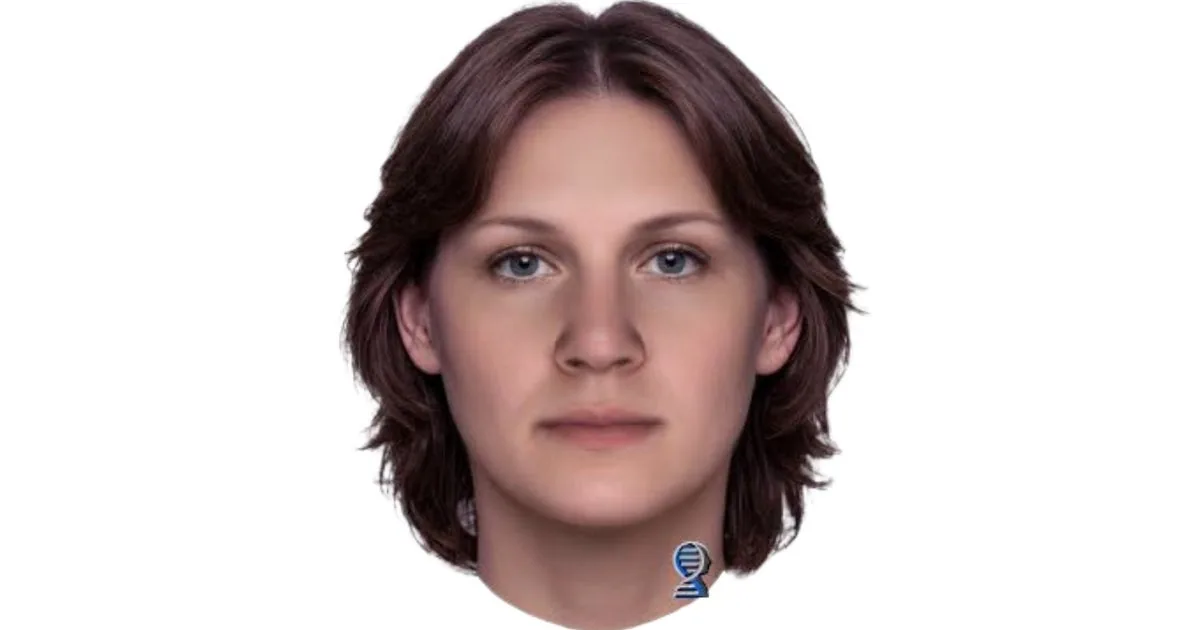
VIRGINIA BEACH, VA — Virginia Beach police are asking the public to help identify a woman whose body was found nearly 50 years ago and has never been named. Using modern DNA technology, investigators have created a reconstructed image of what they believe she may have looked like before her death.
The cold case dates to 1976, when the woman’s remains were discovered in the water near the First Island of the Chesapeake Bay Bridge-Tunnel. Police and the Office of the Chief Medical Examiner are now hoping the new composite image will generate fresh leads in a homicide that has remained unsolved for decades.
How investigators used DNA to build the composite image
Police worked with the Office of the Chief Medical Examiner and Parabon NanoLabs, a Virginia-based DNA technology company, to analyze genetic material linked to the victim. Through DNA phenotyping, the team predicted traits such as eye color, hair color, skin tone, facial structure and freckling.
Forensic artists then used those predictions to create a portrait showing a possible appearance for the woman at about age 25. Investigators said they selected average body measurements as a baseline because DNA cannot determine a person’s age or exact weight at the time the image was made.
The reconstructed face is intended as a scientific estimate, not a definitive likeness. Police said the image can help people recall someone they knew, but it cannot account for features shaped by life experience, including hairstyle, smoking, diet, alcohol use or other non-genetic factors.
What police know about the victim and the 1976 homicide
According to investigators, the woman was likely white and between 35 and 45 years old. Police said she was about 5 feet 6 inches tall and weighed between 135 and 145 pounds.
She also had a five-inch scar on the back of her right thigh, and physical evidence suggested she had given birth at least once. Because of the condition of the remains, immediate identification was not possible when the body was recovered on May 30, 1976.
The medical examiner later ruled the death a homicide and estimated that she had been killed within 48 hours before she was found. Despite that finding, investigators were never able to determine her identity.
Why the Chesapeake Bay Bridge-Tunnel discovery mattered
The location of the discovery has long been central to the investigation. The woman’s body was found in the water near the First Island of the Chesapeake Bay Bridge-Tunnel in Virginia Beach, a spot that made the case especially difficult from the start.
Police said the remains were too compromised for an immediate identification, leaving detectives to rely on the medical examiner’s findings and other investigative steps. Even with those efforts, the victim’s name stayed unknown for half a century.
The new reconstruction gives investigators another way to reach the public. By showing a face instead of only a description, police hope someone may recognize the woman or remember details that had not seemed important before.
Detectives ask the public for tips and family references
Virginia Beach detectives are urging residents and anyone with missing-person information to look closely at the composite and share it widely. People who believe they recognize the woman, or who have information tied to the case, are being asked to contact the Virginia Beach Cold Case Squad Tipline at 757-385-4241.
Police also pointed to another tool that can help identify unidentified remains: Family Reference Samples. Relatives of missing people can voluntarily provide DNA samples that are compared only to unidentified remains and are legally protected from other investigative use.
Families seeking to submit a reference sample should contact the law enforcement agency handling the missing person report. More information is available through the CODIS and NDIS fact sheet, which explains how those comparisons work.
A broader push to solve unidentified person cases
Police said the case reflects a larger national problem. Across the United States, more than 15,500 unidentified persons cases remain unresolved, leaving families without answers and victims without names.
Investigators say advances in genetic technology now offer one of the strongest paths to solving those cases. In this investigation, the hope is that a new face, created from DNA and forensic art, will connect the victim to someone who has been looking for her for years.
Authorities stressed that the image is only one piece of the puzzle, but they believe it may be enough to move the case forward after five decades. For detectives, any identification would not only help solve a homicide, but also restore a name to a woman who has remained unidentified since 1976.