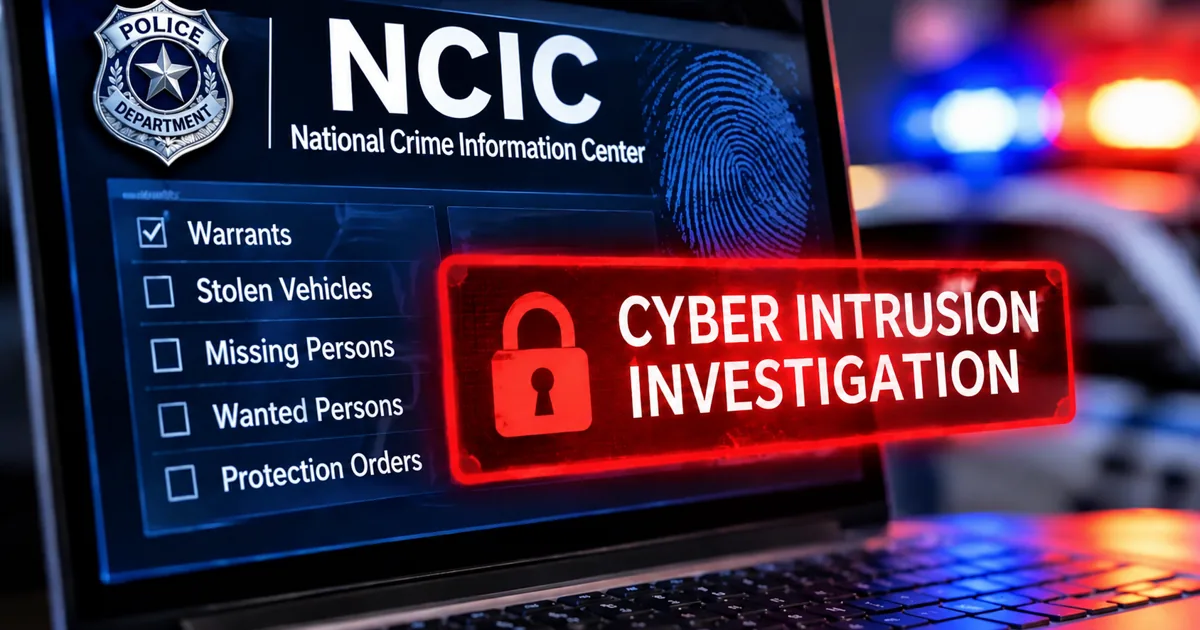
WASHINGTON, DC — The FBI is looking into a possible cyber intrusion involving the National Crime Information Center, a key law enforcement database used by agencies across the United States. The investigation has drawn attention because the system helps police, sheriff’s offices and federal agencies check information that can affect active stops, arrests and searches.
President Donald Trump said Saturday on Fox News that he had only just learned about the reported incident and called it “not good,” according to the Associated Press. Officials have not said whether the database was actually breached, whether access was interrupted, or whether any records were exposed.
Why the National Crime Information Center matters for daily police work
The National Crime Information Center, often known as NCIC, is one of the main tools law enforcement agencies use to quickly confirm critical information. It contains data on wanted persons, outstanding warrants, missing persons, stolen vehicles and protective orders.
That information can matter in routine encounters as well as major investigations. During a traffic stop, for example, officers may use the system to check whether a person is wanted in another state or whether a car has been reported stolen. Because the database is used nationwide, any disruption could have consequences far beyond one agency or one state.
Maryland law enforcement agencies reach the national database through the state’s METERS system, which is overseen by Maryland State Police. That connection underscores how deeply embedded the database is in everyday police operations.
Possible disruption could affect officer safety and investigations nationwide
If access to NCIC were interrupted, police agencies could face delays in verifying information that often needs to be checked immediately. That could slow investigations and make it harder for officers to confirm whether a person, vehicle or order appears in the system.
Officials also have not said whether any sensitive records were compromised. The uncertainty matters because the database supports officer safety as well as basic record checks. Even a limited problem could ripple through departments that rely on fast access to accurate national data.
At this stage, the full extent of any possible intrusion remains unknown. Authorities have not described what may have been targeted or how long any disruption might have lasted.
FBI has not commented as questions continue around the incident
The FBI has declined to comment, according to the Associated Press. That leaves open basic questions about what investigators believe happened and whether the agency has identified a source of the possible intrusion.
Without additional details, it is not clear whether the event involved an attempted breach, a successful breach or some other cyber issue affecting the database. Law enforcement agencies that use NCIC are left waiting for more information about whether their access or data may have been affected.
For now, the case remains an active and developing investigation, with federal authorities offering little public detail.
Separate NSA outage in Maryland appears unrelated
In a separate incident, the National Security Agency experienced a technology outage Tuesday involving its classified internal network at Fort Meade in Anne Arundel County, Maryland. The NSA said the disruption happened during scheduled maintenance.
The agency also said mission-critical operations remained functional during the outage. No connection has been established between that issue and the FBI’s investigation into the NCIC matter.
Although both events involve federal systems and cybersecurity concerns, officials have not linked them. The NSA incident was localized to its internal network, while the FBI inquiry centers on a database used by law enforcement nationwide.
What officials have said so far about the developing investigation
So far, officials have confirmed only that the FBI is investigating a possible cyber intrusion tied to a major national police database. They have not said whether records were accessed, whether service was interrupted or how widely the issue may have spread.
The Associated Press reported that the FBI declined to comment, and the extent of any intrusion remains unknown. That leaves the public picture limited to a few verified details and several unanswered questions.
Because NCIC is used across the country, any confirmed compromise could have broad implications for policing and public safety. For now, however, the situation remains unresolved while investigators continue their work.